
10 Worship Piano Patterns for Right Hand
One of the easiest ways to make your worship piano playing sound fuller and more musical is to learn a few simple right-hand patterns.
You don't need complicated chords or advanced piano techniques. In fact, many of the most useful worship piano patterns are built from the same basic ideas: broken chords, repeated notes, simple melodic movement, and rhythmic repetition.
The key is knowing what to play and when to play it.
In this article, we'll look at 10 right-hand patterns you can use when accompanying worship songs. These patterns can be adapted to different tempos, chord progressions, and worship styles, giving you a practical vocabulary you can draw from while you play.
In this video, I demonstrate each of these 10 patterns:
1. Basic Chording
Play all the notes of your chord together, playing once on each beat:

This creates a simple foundational rhythm for your song, and it is what I recommend that all beginning pianists start with, in order to develop a sense of rhythm in your playing.
2. Skip Beat 3
This pattern is similar to the Basic Chording pattern (above). Instead of playing on every beat, we play only on beats 1, 2, and 4. We skip beat 3, or more precisely, we hold the chord down through beat 3.

3. Decorative
I call this the Decorative pattern because it serves as an elegant “decoration” when there is some space in your song and you are looking for an appropriate way to fill it. For this pattern, we play the chord on beats 1 and 2, hold the chord through the first part of beat 3, and then play the 3 notes of the chord as eighth notes from bottom to top.
(Be sure to watch the video above to see the exact timing for this pattern!)

4. Rocking
For the Rocking pattern, we play the top 2 notes of the chord, followed by the bottom note, “rocking” back and forth between the top 2 notes and the bottom note. Be sure to keep a bit of wrist-forearm rotation to make this pattern more comfortable. (Watch the video to learn more about this rotation technique!)

5. Rhythmic
This pattern works great for bigger moments of your songs. For this pattern, we play our chords as 8th notes. (Watch the video to see how to “pulse” the pattern to make it sound musical.)

6. Arpeggiated
This pattern creates a delicate, meditative accompaniment:

7. Flowing
This is a beautiful eighth note pattern that adds gentleness and subtle rhythmic variety to your playing. (Be sure to watch the video to hear this pattern demonstrated.)

8. Variation of Rocking Pattern
In this pattern, we form our chord and play as eighth notes: top-bottom-middle-bottom. This is a pretty pattern that can add interest and variety to your playing.

9. 16th Notes on Beat 4
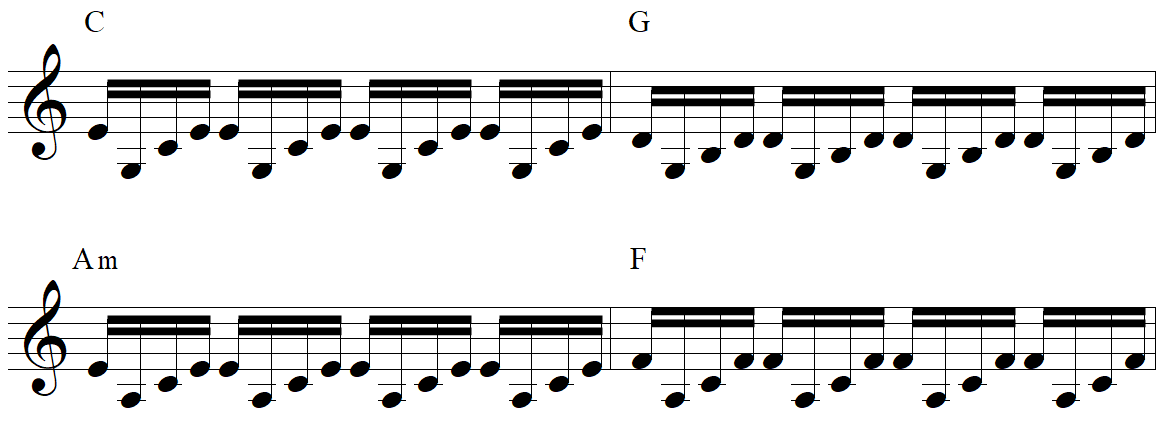
For this pattern, we play a chord for beats 1, 2, and 3. On beat 4, we play as 16th notes: top-bottom-middle-top. This pattern works well to add energy when leading into the next measure or chord.

10. 16th Notes on Every Beat
In this pattern, we play the 16th notes on every beat: top-bottom-middle-top.
Putting These Patterns Into Practice
The goal isn't to memorize 10 patterns and play them constantly. The goal is to develop enough vocabulary that you can choose the right pattern for the moment.
Start by taking a simple worship song you already know and experimenting with just one pattern at a time. Try the same pattern during the verse, chorus, and bridge and see where it fits the best.
Then experiment with a different pattern, using a different octave, or combining the pattern with various left-hand accompaniment patterns.
Simple patterns become powerful when you learn how to use them musically.
If you want to develop a larger vocabulary of practical worship piano patterns, these ideas are a great place to start. The more patterns you learn—and the more you practice applying them to real worship songs—the more naturally you'll be able to create accompaniment that supports the song instead of simply playing the chords.
Want to Learn More?
Want to keep growing as a worship pianist? The Worship Piano Membership gives you a clear, step-by-step path to playing with confidence and freedom—all from a heart of worship.